April 8th poem

Saturday, April 08, 2017

A Litany of Bodies

My body is alone in the co-working space,
chill in here and sunny outside, and
My body takes a break to study a photo
of an injured child in Syria,
Body’s head falls into body’s hands.
The body of the child is being attended to,
but it isn’t clear how his
Body is being supported.  One medical worker
seems to guide the child’s head to look
At the body of an older sibling.  They look into each other’s eyes,
the injured child’s eyes huge. 
A second medical worker prepares to suture.
Adult bodies look on.  “Civilians.”  Human beings,
Their bodies leaning in to support the child with their presence.
The body of a girl child is in the foreground,
also looking on, an adult’s hand
On her head.  That’s what made me cry, all the looking. 
These children have seen something together
that will separate them
From the bodies of those of us who haven’t
seen it, haven’t been there
With our actual bodies.  In Michelangelo’s Pietà,
The adult body of Jesus is cradled in his mother’s lap,
And this is what’s so terrible and beautiful
about being a mother.  To hold
The body, to cradle it, to send it out into the world,
the brutality of the world
Upon the body, which if we are to believe
the religious among us, houses
Also a soul.  Tell me.  Are we, then,
to believe it?


April 7th poem

Saturday, April 08, 2017

Fortuitous Poem 

I feel bad for Sylvia Plath's Esther, trying
to read Finnegan's Wake in the middle
of a nervous breakdown.  This morning, the sun
on the dining room table-- we have a table now--

and I notice that my local goat cheese looks like
an angel when I first spread it on my sprouted bread.
This is the problem with lyric poems and class rage.
If I weed the irises and have a dining room table, I

suspect myself.  Everything must happen for a reason.
Isn't that what Voltaire's fool said?  I will stop trying
to solve the equation of human suffering-- X people
stuck at airports plus X people killed in a gas attack

minus whatever our government is doing plus whatever
our government is doing ... Meanwhile I'm here in a room
managing my small son, who has sensory problems at
the classroom Shabbat.  Too many people in one room

plus the singing plus the rabbi coming in and reading
a book equals E. turning to shove one ear to my chest,
then bursting into a different state, shouting out in the middle
of the Passover book, "Why didn't they free themselves!"

and hopping about the room.  "Then Moses parted the sea,"
the rabbi says patiently.  I gather up my child as the book
ends.  I go home and try to weed, but he cries about
the "poor little weeds."  Later he tells me he stops

loving me when I'm mad, but starts again later.  I've
been so often mad during these months.  I want to say
something about "let my people go," which tradition is
partly my son's-- enslaved ancestors-- but I also want

to say that in Adonis' Syria, being a poet earns you
the threat of death.  Speaking and not speaking do
matter.  For a week, I lost the Swiss Army knife

I carry with me everywhere, but yesterday
I found it among the spatulas.  

April 6th poem

Thursday, April 06, 2017

"He is paralyzed by something happening far away" --Tomas Tranströmer, "Lament"


Lament: Five Ways of Looking

1.  Four year-old comes in from playing at dinnertime and says, "What's happening now?  What's happening now in another town?"  He wants to know if it's night anywhere in North America.

2.  It is night, and his father and I are sitting with our failures as parents, tender toward each other then.  "And then there's ..." I begin, then change the subject.  He asks me what I was going to say.  "Oh, nothing.  I was just thinking about mortality."  I give up and go to bed.

3.  In the morning, NPR is on in the kitchen as usual.  Some mornings we talk in an animated way about the government, making exclamations.  Today I say, "I can't talk about the government right now."  C starts to talk about controlling what you can, about the long game.  "I can't talk right now," I say.  And it's true.  Here are the words that occur to me when I try to think about it: "struck dumb"; bereft; done; still; again.

4. We rediscover a book of poems the landlady gave E for Christmas a couple years ago, the kind of book you might circle back around to at different times.  He is struck by a poem about a baby eating a microchip and doing his father's taxes. "What if I ate a microchip?  What if the poem was about me?" Eyes sparkling.

5.  I let him play with the hose, experimenting with watching him from the kitchen window.  He keeps leaving it on and coming in the back door.  "Go turn it off if you're coming in."  "I'm not done!" He tromps back outside and plays with it some more, then leaves it on and comes back in.  "Go turn it off if you're coming in."  "I'm not done!" And etc.  The Beckettian mother-child dyad.  The performance art that is being a young child.  The vaudeville act we would be if you could see us. All that water buys me only enough time to put water on the stove for spaghetti.  He finally turns the hose off.  As he is taking off his rain boots, he tells me that the hose was crying.  "It was laughing, and now it's crying.  It has tears in its water-shooting eyes."


April 5th poem

Wednesday, April 05, 2017

Wilderness Ghazal

My grandfather knew and my great-grandfather how to navigate in the woods,
How to find solace in them. I haven't studied the constellations, am still lost in the wilderness.

While the men wandered in the woods with hounds and guns or their own night sky minds,
The women stayed behind and watched the children, that constraint its own wilderness.

And it's true my mother was a feral child, having set fire to the woods that time,
Having run all over town, doing what she wanted within her power, that wilderness.

What was I saying? I've spent a lot of time roaming around there, like that dream,
The black dog by the water's edge, devouring books, vomiting the pages.  Wilderness.

I am named Penn Cooper for my mother's first husband.  When I was eight,
He brought me a swiss army knife, then left again.  I carry the knife with me everywhere,
          prepared for the wilderness.


April 4th poem

Tuesday, April 04, 2017

Engima Poem

The way a crow turns and jumps into the air
as I round a corner in the car, as if posted there
to report my movements.  The way I used to tap
on my side as a child, counting syllables,
and when a teenager three light taps for bad thoughts
or wishes.  You had to avoid cracks in the sidewalk, even
dividing lines between concrete squares.  Thinking
of it now, a wave of affection for myself as lurching,
tapping small person, eyes drifting up to the right
to figure out the counting. As I write, my eyes drift up
to test it, then fix on moving clouds above the doctor's
office parking lot.  I study spring limbs stirring, present
despite myself.  Yesterday my son paused on our way out
of a room to point to window, excited. "Look!  A spring
breeze!"  Once in Michigan I was very small and the wind
so fierce it lifted me in my snowsuit as I clutched my mother's
hand.  There is only so much I can teach my son--  salt over
the shoulder, April Fool's, the habits of the bower bird,
how a kite lifts off the ground, how it drags.  After that,
as my granny said, he'll take off on his own skates.

April 3rd poem

Monday, April 03, 2017

Elegy at 45

A friend’s message says she’s too angry to be
Buddhist today.  There is loss and there is loss
and there is loss and there is loss. I read my
horoscope.  Life is not a puzzle to be solved,
it says.  It’s hard to break a lifetime habit of seeing
one’s life as the plot of a novel.  Didn’t Aristotle
say something about plot?  But then, he saw women
as flower pots.  When my son was born, my mother
said, “Now you’ll never be alone again.”  My look
of panic then.  Elegy for loneliness.  Elegy for
an earlier self-image.   Elegy for my sex drive
and the different shape my vagina used to have. 
There is some normal degree of relaxation. 
The new gyn says that. If you think I’m making
a joke of my body, that’s on you.  (She’s spiraling,
you might say.)  Elegy for my lost spinsterhood,
elegy for city life, elegy for the polluted earth
of my childhood, elegy for the atmosphere, elegy
for when I saw the university as a haven, elegy
for my youthful arrogance, elegy for
my impatience with men noticing my youthful
“blooming,” elegy for being a poor kid a white girl
a reader a professor.  I taught the Modern Tradition
once. The male professor who hired me (lovely man)
asked me about my look of anguish, told me
to “project it outward.”  Listen, if I start projecting 
it outward now I will never stop watch out.

April 2nd poem

Sunday, April 02, 2017

Recipe for Success

It's hard for me to sleep when I've had two glasses of wine,
and I'm off Facebook. I sneak back on and read about the measles
outbreak in Romania, before turning over and listening to a podcast
about West Nile and werewolves. Now that I'm a mother, I have some
skin in the game, which skin is currently on my laptop with a learning
program so I can write this.  Even as I write, he emerges naked, gliding
through the hall holding the silver Apple aloft, heading for the potty.
I hear him settle in, watching an educational video about plants. It's all
being explained to him.  At bedtime, I tell him a story about a campfire,
the chill feeling on your back and the heat on your front, the hypnotic
movement of reds and oranges over the burning wood, the crackling,
the freshness of the air around.  He says, "That's because trees breathe
in carbon dioxide and breathe out oxygen.  And people breathe in oxygen
and breathe out carbon dioxide.  Isn't that funny?"  Later he'll have to
vomit it all out, the world, and start over in front of an actual fire,  staring,
aligning his body and mind with the elements.  In the actual woods
he'll gather soul power for the days to come.  Someone has to.

April 1st Poem

Saturday, April 01, 2017

I'll be participating in NaPoWriMo again-- for the seventh (!) year in a row.  This first poem is my take on a haibun, as per the early bird prompt on the NaPoWriMo site.  It also mentions Kay Ryan, who was part of the April 1st prompt.  I'll take down the poems at the end of the month to assess what I have and revise some of them.  Happy poetry month, everyone.


Saturday Morning 

I'm in the kitchen with my four year-old trying to find a moment to unload the dishes.  He wants to write in a notebook with a pen, and I have the idea to give him a checklist with boxes he can mark off after completing each task.  I set him up at his little green table with last night's modeling clay still on it.  The task list is the following:

  • Write an E
  • Draw triangles around the holes in the paper
  • Make a vehicle out of clay
  • Make a ramp out of clay
(But with check boxes.)  He decides to draw a "three-wheeled mouse seater," narrating as he works.  He adds a tarantula.  He writes an E that doubles as a tarantula web.  He models a moon rover out of clay.  He models a ramp.  He tells me that he can't make triangles and draws squares around the holes.  He makes a clay snake named Fern-- a woman snake-- and he makes Fern's baby, Fernafalla Fellini Foo.  (I experience momentary terror, certain that school will kill his spirit.)  

I pause in what I'm doing and lean against the counter, looking at a book of poems by Kay Ryan. "Listen to this," I say.  "This poem is called 'The Fourth Wise Man.' "  I read the first few lines: 

The fourth wise man 
disliked travel.  If 
you walk, there's the
gravel.  If you ride, 
there's the camel's attitude. 

He interrupts to say, "What if the fourth wise man accidentally got on a plane?  What if he or she accidentally landed in Africa?"  I say, "You mean, and accidentally met Jesus?"  (I explain that Jesus was in the Middle East.)  He knows about the three wise persons from Ramona and Her Father.  At the Christmas pageant, Ramona is a sheep and the three wise men are played by older girls who take over after the boys drop out, making the roles their own.  In fact, he knows about Jesus from Ramona, too.  I tell him then that people still talk about Jesus because they liked what he said about peace and love.  My son says, "I don't like him.  I like to be loud."  I say he can make a "joyful noise unto the Lord." (Also via Ramona, who makes "a joyful noise until the Lord.")  He makes a fanfare noise.  He tells me he loves everyone he knows, and everyone on the whole earth, and that he even loves aliens.  He asks me if Jesus is dead.  He asks if the people who buried Jesus are dead.  

Saturday morning, I tell
my son about the rock rolled away 
from the tomb.  He looks at me.  


Five Facts about Facts

Tuesday, March 28, 2017

1. My mother saved many of my old worksheets from one or two of my elementary school years, which is why I know that when I was in 3rd or 4th grade, we had to do a worksheet in which we differentiated between facts and opinions.  We also had a unit on different advertising methods-- the bandwagon approach, celebrity endorsements, etc.  What we were expected to do in Language Arts at that young age astonishes me now.  This was a public school in a not-well-off area.

2.  My recently-turned-four year-old sits on the potty and demands an audiobook.  I tell him that he needs to sit and think for a moment, that he's just thrown a hard ball at my face without thinking and he needs to slow down.  He retorts, "I don't want information about myself!" Then asks, "Is that information?"  I tell him that it is.  His brain is working on a lot of things, which seems to make it harder for him to control his body.  Later at the museum, he reads me a sign about an island-- having somehow taught himself to read in the last month or so-- but pronounces it "is-land."  I tell him what the word is and he tells me that, no, it says "is-land."  Outside at the museum, he asks me to play bad guy.  I am a super villain who is wreaking havoc, which he can fix with his robot hands.  Finally, I run out of ideas for havoc, and when he asks me what problem I will cause next, I sit on a large rock and tell him, "I've turned into a rock."  He says, "Don't cause problems with yourself.  Cause problems with the world."

3.  Then there's the time Amanda and I got drunk in graduate school and conflated two nineteenth-century novels, retelling the plots to each other in a folie a deux of misremembered narrative.  A grad student a deux.  A folie a whatever you call the shared mind that close female friends move in and out of, Jesse laughing at us from across the table.  (Nevertheless we persisted.)

4.  Ghosts.  I would like to speak to someone who has seen an actual ghost.  Most of mine are vivid dreams or confusions upon waking.  Even many of the stories recounted on the show Celebrity Ghost Stories seem to me to have been particularly vivid dreams.  Some involve voices coming through telephones.  But there was one that featured an actor and his wife on a bike tour of Ireland.  They stopped to walk around a long-abandoned village, interacting with people who, they later learned, were no longer there.

5.  Most hotel rooms feel haunted to me, but this may be because I am an "intuitive" who picks up on lingering energy.  There are two kinds of people in the world, and one of those kinds uses the word "energy" in that way.

Seven Facts about Roses

Thursday, March 23, 2017


1. In Salisbury, NC when I was a kid there was a discount store called Roses.  I think it was near Bob's Big Boy.  One time my uncle John took me to the Bob's Big Boy and cut up my spaghetti for me.  I liked how he went out of his way to take me places and let me know I was loved, but I questioned his spaghetti technique.

2.  A dear friend I know from the computer sent me a care package a few weeks ago-- tea from the farm of a Catholic witch; a rose oil candle to bring out my inner saint; some peppermint oil to wake me up.  It's nice when we can all take turns caring for each other.  Enough to go to the post office, even!

3.  The rose candle is burning now.  It's Reiki charged.  This morning my four-year-old took it off my dresser, then saw me open my eyes to see what he was doing.  Without my glasses on, I couldn't tell what he had until he brought it over, saying, "Here, smell this."

4.  Rose-scented products make me think of my mother, and for some reason I have found them especially comforting since the election.  First, I bought myself some rose-scented hand lotion on sale, in a shaky "I-can-still-buy-myself-rose-scented-hand-lotion" gesture.  Then I received this candle.  "If we share this nightmare/ Then we can dream Spiritus mundi."  The Police said that.

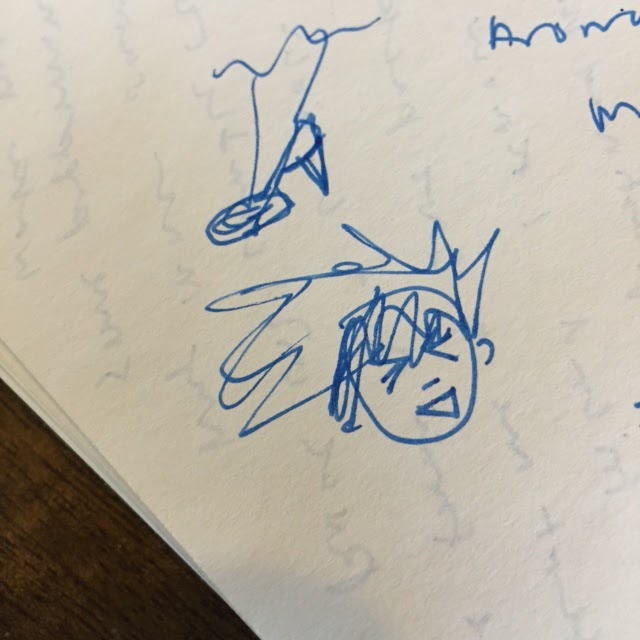
5.  Life can be traced in a history of doodles.  Sometime around seventh grade, a rose doodle, which I can't remember how to draw now.  Around eighth or ninth grade, I learned how make a high-heeled shoe.  By tenth grade, a face with squinched-up eyes and Robert Smith hair.

6.  I have found myself unable to commit to growing flowers.  People born in late June are supposed to be homebodies and flower growers, but I keep moving house.  I may look into some plants for spring, but roses will have to wait a bit longer.

7.  On a whim, I Googled "Joan of Arc rose."  According to the Antique Rose Emporium,
Jeanne dArc is a dainty but vigorous rose with semi-double, pure white flowers borne in clusters. Like all Noisettes, it betrays its Musk ancestry by a grand fall display and a strong fragrance. Attractive red hips often appear at the same time as the flowers. It is best used as a pillar so that the flowers may be readily seen, or it can be grown as a free-standing bush. Wherever it is planted, Jeanne dArc will create an almost perpetual display of Southern beauty.  OK, then.  

Cultivate and circulate

Sunday, March 12, 2017

Three things:

1.  Today I was in a horrible mood, and I made myself go for a nature walk, during which I began to feel better.  In fact, I received a prophecy from some sunbeams on my walk.  (See picture.)  The prophecy was something like, "What was that poem I wrote that used the word 'circulate'?  Look at that again."  I found it!  It's called "Our Biography," and I originally posted it on this blog.  Here.


2.  I have a new Instagram project (if such a thing exists) in which my friend Jessica Mesman Griffith and I post weird insights into the lives of melancholy moms.  Tips on creativity and mothering.   Not really.  It's more like if the troubled teens from Heavenly Creatures grew up to be disaffected Gen X mothers?  Er, maybe not.  Maybe it's about how to stay alive by allowing yourself to be inappropriately amused by that which you find unsettling?  I really need to work on my elevator pitch.  For my new Instagram account.      

3.  Here's an excerpt from the essay about my relationship with the Beatles I may or may not be working on:  The next day, Granny is peering out the front window at dusk to see who has a candle out for John, muttering, “I lit one for Kennedy, but I’m not lighting one for him.”

OK, good night!  Happy full moon, I guess.  


Community Writing Workshop

Sunday, February 26, 2017

I'll be teaching a writing workshop at Nido Durham on Saturday afternoons March 11th to April 15th.  Enrollment is limited to 8 participants.  Join us to jumpstart your writing practice!  Register at bit.ly/jpcspaces.


Similar Boat

Monday, February 13, 2017


1.
My son, almost four, asked me what happens after people are buried in the cemetery.  As gently as possible, I suggest that their bodies become part of the earth and their souls go up among the stars.  He starts crying and says, "Promise you won't let that happen to me." 

2.
I drop him off at preschool after a weekend alone with him.  He is to decorate a book about his family that has photos pasted inside.  "Maybe you should draw Mimi and Bibi," I say.  They didn't print that picture out, so my parents aren't in there.  While I talk to the preschool teacher about his stubborn weekend, he draws a train, an infinity sign, and a pirate.  "Show Ms. B your 'ignoring face'," I say.  He rolls his eyes up and to the side, then closes them and lifts his eyebrows, setting his mouth imperiously.  "That really is the best face," the teacher says. 

3. 
Why I'm a poet:  
Once, around the year 2000, my mother visited me in Philadelphia, where I was in graduate school.   I took her to campus with me, and we saw a blond young woman walking along wearing black platform shoes which, in the style of the day, looked vaguely orthopedic.  "Look," I said.  "It's one of my students."  "That poor girl," my mother responded dryly.  "She has two club feet."  

4. 
I am writing in a small notebook that I've been losing and finding for a few years.  I find something I wrote in late summer 2012:  " 'In my delicate condition.'  I was born in a delicate condition."   

5.
I go to the food co-op and drink a cup of dark coffee with half and half.  On a lark, I sprinkle nutmeg in it.   I see that they have more of the heart-shaped maple apple hand pies made by a local pie company, and I buy another one.  This will be my breakfast.  I know the woman who made this pie.  I know that she was diagnosed with and treated for thyroid cancer shortly after she received insurance through the Affordable Care Act.  Her daughters used to be in preschool with my son.  They have the sweetest faces, the dearest love for one another.  Their gazes are steady and assessing.  

6. 
On a visit to my grandmother, she tells me, "Everyone is a little crazy."  She says that her mother used to say that.  On her coffee table is a book of essays by Marilynne Robinson I gave her for Christmas and a Time with Bannon's face. 

7.  
I find this in my small notebook:  "How do I spend my remaining time upon the earth? etc."  Elsewhere I've written a note to remind myself to write a poem titled "Similar Boat."  

Kentridge

Monday, February 06, 2017


source: MoMA


I've been thinking a lot about William Kentridge's work lately. I saw a Kentridge exhibition at MoMA in 2010 that stays with me. His work seems relevant to what I was talking about with a group on Sunday about how/why to make art at this time. Our talk led to ideas about how form might need to be interrogated in this cultural moment, and we brought up things like collage; living with the questions; making your own genre or existing at the intersection of genres; and situating oneself in relation to larger social structures. Kentridge uses many of these methods, as does the poet Claudia Rankine, who we brought up in our talk. I think this is a time to read, view, and promote the work of artists of color, and in addition to Rankine, I find myself turning to the poetry of Lucille Clifton and Joy Harjo, the art of Tatyana Fazlalizadeh and Teju Cole. It's also a time for white artists to continue to interrogate and help crack open the structures we're working within, which is why I'm sitting with Kentridge this morning.

Seven for today

Friday, February 03, 2017


1.  My son called 911 this morning (again).  He was supposed to be listening to his Ramona audiobook on headphones so I could sleep for another twenty minutes, but he fiddled with the locked phone until it made an emergency call, then he handed it to me.  "Here, you talk."  I opened my eyes to see what he'd done, then panicked and hung up.  They called back a minute later.  "No, no emergency.  Just my three year-old.  Sorry."

2.  I ask a friend to tell me to write 500 words.  She tells me to write 500 words.  I pick up a favorite book, Abigail Thomas's Safekeeping, to remember about writing, about narrative windows into a life. I read about Thomas's second divorce.  "There were no happy answers," she writes.  I read a sad part about how her parents paid for her son to go away to boarding school, and he called her, homesick, begging to come home.  She writes, "Some things are so sad you think they can't get better and nothing will be ok.  She didn't make it better, although she tried, later.  It got better by itself."

3.  Yesterday we went to the playground for the hour before sundown.  My son keeps asking me if it's still winter.  I say that it is, even though some of the days have been unseasonably warm.  Yesterday was Groundhog Day.  The beginning of February is also Imbolc.  The park we go to is a sort of oval basin of lawn with stone steps at one end.  We run into three girls from preschool there, two of whom are twins.  The non-twin really wants E. to play with her, and she crouches beside him as he stuffs old leaves into the bottom of an overturned riding toy.  "Elias, do you want to play wedding?  Do you want to play wedding, Elias??"  Finally, with some prompting from me, he replies, "I want to play digging."  Later, he tries to join his friends as they climb up one structure and hop onto another on repeatedly.  One of the twins tells him the game is only for girls.

4.  Before we leave the playground, E. becomes increasingly tired and hungry.  I can see it in how he begins to roam around, looking for opportunities to be belligerent.  I try to coax him toward the car with the promise of peanut butter crackers, but it's only when I distract him by pointing to the clouds that he agrees to be picked up.  "Are they stratus or cumulus?" he says.  I'm not sure.  Stratus, maybe. "All clouds are made of water vapor," he tells me.

5.  I've been very angry, I tell my friend over text.  So have I, he says.  And it's slipping out in the wrong places.  Yeah, I say.

6.  This morning after the 911 call, my son wanders into the kitchen to oversee the coffee making.  It is his job to smell the coffee after it is ground, and he becomes agitated if he misses the chance to do it.  I try to doze again, but find that I am agitated.  Is it an emergency?  I say a spontaneous "Hail Mary."  I'm not Catholic, but I've always loved Mary, and I like the idea of "hailing" her.  "Hail, Mary.  Come in, Mary.  Over." By the time I am at the end of the prayer, my body has relaxed.  May we all be cared for.  All of us poor sinners.  All of us who care for others.  Now and at the hour of our death.

7.  What I wanted to say was that there were all kinds of people at the playground.  I stood over my son, watching him stuff leaves into an overturned toy with another boy as they made "dragon soup," and I thought, "This is America.  This is America.  This is America."

Days

Wednesday, January 25, 2017

What is there to say?  Dread.  Resistance.  Life going on as usual and not at all as usual.  I want a place to say, "Here are some of the details of life.  The texture of lived experience."  To continue my own way of speaking.  

Some recent detail:


[poems by Marie Lundquist from The Star by My Head: Poets from Sweden and by Lucille Clifton from Blessing the Boats: New and Selected Poems 1988-2000]
Proudly designed by Mlekoshi playground